Assistx
Conversational AI


2026
London, UK
Conversational AI Portfolio
A portfolio you can question and operate, where every boundary is enforced, not promised.
I started a conversational portfolio in 2021 and launched it in 2024. In 2026 I rebuilt it as an agentic product: an assistant that can act, not just answer. Visitors can question my work and reach me, while every action that matters waits for a person's approval and every claim shows its evidence.

My decisions, bets and trade-offs
- Decision
I made the portfolio itself the proof by embedding inspectable tool contracts, permissions, and evidence in the product. That made the case study more precise, but strengthened the argument because readers could test the work. Why
- Decision
I used explicit field allowlists to keep data that should not cross into a model's context out of it. This made the boundary depend on system rules rather than a prompt asking the model to ignore the data. Why
- Bet
I kept prediction switched off until it proved accurate enough. A wrong visitor-facing change could cause damage rather than simply help the system learn. Why
- Trade-off
I required a server-held one-time code and a person's exact confirmation phrase for consequential writes. I accepted the extra friction because a model should not be able to manufacture the person's agreement. Why
- 100Lighthouse accessibility scoreThe portfolio received a 100 accessibility score in the Lighthouse audit.
- 93Lighthouse performance scoreThe portfolio received a 93 performance score in the Lighthouse audit.
- 0.98 confidenceQuestion routing confidenceA fresh question on the approved theme routed successfully after an earlier question had fallen through.Reported
Context
In 2021, I began with a specific idea: a portfolio a hiring panel could talk to, with a 3D stage. Instead of making people follow a fixed sequence of pages, I wanted them to ask about a decision, find the evidence and explore the work in their own order.
The first version went live in 2024. I submitted it to FWA, and it was an Awwwards nominee that year. It brought conversation and a three-dimensional environment into the portfolio. This case study follows that idea through its second version, rebuilt in 2026 as an agentic product.
The point of the rebuild was not to add AI for its own sake. I wanted the portfolio itself to demonstrate how an AI system can make its capabilities, boundaries and evidence inspectable.

Challenge
Version one had to bring several technologies together while keeping the experience usable across devices. It could answer questions, but conversation logic was split between Dialogflow intents, prompts and server routes. Adding a capability meant another endpoint and more client-side code, while Dialogflow sat on the critical path for behaviour the product did not fundamentally need.
Version two changed the nature of the problem: the assistant could act, not just answer. A visitor and I might see the same interface, but they should not have the same access. If the system carried out a private action for a stranger, even once, that would be a boundary failure, not a minor usability defect.
I could describe trust as a principle, or build a system that made the principle testable. The rebuild had to make clear which capabilities existed, who could use them, what data crossed a boundary, and what evidence supported each claim.
Approach
I moved the capabilities into a Model Context Protocol server, where each tool has a typed contract. That gives the system one inspectable place to define what the assistant can do, instead of spreading capability across prompts, endpoints and browser code.
I separated access by who is asking. Visitors see visitor-appropriate tools, and restricted actions are checked again when called. Hiding a tool improves the interface, but it is not the security boundary by itself.
I treated data exposure as a boundary problem. Explicit field allowlists remove data that should not cross into a model's context; the system does not rely on a prompt asking the model to ignore it.
Writes wait for a server-held one-time code and a person's exact confirmation phrase. Evidence is handled with the same care: figures carry provenance, and the narrative distinguishes a design or product outcome from a measured one.
I used the system on real portfolio work as part of validation. That exposed real faults: an article parser stopping at 512 tokens, a mistyped argument being silently ignored, and a document write replacing fields that should have been preserved.
Decisions
I made the portfolio itself the proof. Rather than only describing trustworthy AI, I made the tool contracts, permissions and evidence part of the product a reader can inspect. That means the case study has to be precise, but the argument is stronger because the work can be tested.
I kept prediction switched off until it earns enough verified correct guesses. A wrong prediction in a chart is something to learn from; a wrong prediction that changes what a visitor sees can cause harm.
I chose a two-part approval for consequential writes: a one-time code held by the server and an exact phrase entered by a person. It adds friction, deliberately. A model should not be able to manufacture the person's agreement.
I shipped the rebuild in small, independently reversible changes rather than one large rewrite. That left two ways of doing things in place for a while, but each change could be rolled back on its own.
I made the evidence boundary visible, including which claims are measured, reported or unmeasured. It is less conventionally polished than showing only the strongest numbers, but more useful to someone deciding what to trust.
Results
The rebuild is live and still evolving. The portfolio is no longer only a conversational front end: its capabilities, evidence model and approval path can be inspected as parts of the product.
A hiring panel can explore my work by asking questions in its own order. A reader can inspect where a claim comes from. Visitors can use an approval-gated contact flow, and an AI agent can read structured work rather than trying to extract it from a PDF.
The learning loop has also worked end to end. A visitor asked a question the router could not place. The system kept it as a candidate with its evidence attached rather than guessing. After I approved it, a fresh question on the same theme routed at 0.98 confidence, where it had previously fallen through.
Prediction remains switched off for visitor-facing changes. It has one verified correct guess so far, short of the twenty needed before it can steer anything a visitor sees.
Two independent reviews examined the architecture and interface. The architecture review found two faults in code written that week: an anonymous-data rule that existed in a comment rather than at the boundary, and a consent check that would have treated the text false as agreement. I fixed both within the hour. For me, dogfooding does not prove the system is finished; it helps expose where its principles are not yet enforced.
The Lighthouse audit recorded 93 for performance, 100 for accessibility, 96 for best practices and 100 for SEO.
Reflection
Version one showed that a portfolio could be a conversation. Version two raised the standard: once a system can act, it has to be designed around what it refuses as carefully as what it can do.
The rebuild mattered because permission became something the system could enforce, not just something I could describe. The most convincing part is not the claim that trust is the product. It is that a reader can inspect and exercise the boundaries behind that claim.
Using the system on my own work kept finding gaps between written rules and enforced checks. Dogfooding is not proof that the system is complete. It is a way to find where the implementation still falls short of the principle.
Next, I want prediction to earn the verified guesses required before it can affect a visitor's experience, and to keep turning important written rules into enforced checks.
Prototype
The live experience is the prototype. Every change ships behind its own pull request with tests and stays revertable on its own, so the portfolio is continuously in the state being described rather than a snapshot of it. The admin side draws the intent journey map, the activity and task skylines and the behaviour score, each one the direct descendant of a slide from the 2023 model.
The visitor side is the portfolio itself, which adapts as it is explored.
Tools & Skills
Concept, interaction design, UX architecture and the case-study content model, from the v1 launch through the v2 rebuild.
Intent design, retrieval grounding, tool and prompt design, and the guardrails that decide what an agent may do rather than what it is asked to avoid.
Scope-based tool visibility, an approval gate holding server-side nonces for write actions, and field allowlists that remove data at the boundary instead of instructing a model to withhold it.
TypeScript, React and Next.js; 3D scene work in React Three Fiber; motion design; and an accessibility floor enforced by tests rather than review.
Python service design, MCP tool authoring, Firestore modelling, embeddings and retrieval, and deployment on Cloud Run.
Token architecture with Style Dictionary, a Figma component library, and a drift check that makes 'has the design moved' a question you run rather than argue.
Tech Stack
Next.js 14 with the App Router, React 18 and TypeScript across 473 source files. Redux Toolkit for application state, Tailwind CSS with shadcn primitives, Framer Motion and GSAP for motion.
Three.js via React Three Fiber and Drei. The canvas is the conversation's stage, driven by a documented intent event architecture so canvas state and conversation state cannot disagree.
CopilotKit carries the agent-UI protocol. Models are selected per task rather than globally across OpenAI and Anthropic.
A Python Model Context Protocol server on Google Cloud Run: 40 registered tools across 108 modules, covered by 93 test files. Firestore holds the project corpus and vector embeddings serve retrieval.
Style Dictionary generates Tailwind config and CSS custom properties from one token source. A Figma library of 37 component sets and 145 variants binds to the same tokens, and a bidirectional alignment check reports drift.
React, Next.js, Redux Toolkit, a Flask backend, Google Dialogflow for intent and OpenAI for generation, with Three.js for the 3D environment. Animations were authored in After Effects and Blender.
A capture module on every surface and an event proxy that adds identity from a cookie the browser cannot read, so the page never holds the key.
Nine Firestore policies delete expired records without anyone remembering to. The deletion is the mechanism, not a promise.
The event list exists twice, once in TypeScript and once in Python. Both continuous integration runs read the other repository and fail if the two drift.
The intent behind a conversation turn is derived from the tools the assistant used, not from a second model call.
UX Accessibility
Accessibility decisions are enforced through constraints rather than informal review. Text colors cannot use alpha transparency because contrast would depend on the background and become unverifiable. The three-dimensional experience is also not a required route: every project remains reachable, readable, and linkable without entering the canvas.
The controls the intent work added are keyboard reachable and announce their state: a filter that is on says so to a screen reader rather than only looking different. Reading depth is a real control rather than decoration, so a visitor picks how deep to go and the page changes what it contains.
Experimentation & Rollout
Version one shipped as a launch, while version two is released continuously in small, independently revertible pull requests with attached tests. The new services are also validated through real production-like work: using the parser and project tools to write this case study exposed token limits, swallowed arguments, and destructive update behavior that fixture-based tests had missed.
The intent capture shipped dark first, reading a flag, so the two halves of the system could not get out of order while one was still being deployed. Its steering gate opens on measurement rather than on a date: at least twenty verified predictions and at least seventy percent accuracy before anything a visitor sees is allowed to move. Anonymous visits are session scoped and die within a day; introducing yourself keeps a profile for ninety days, and one control erases the name, the profile, the cookie and every derived analysis together.
Disclaimers
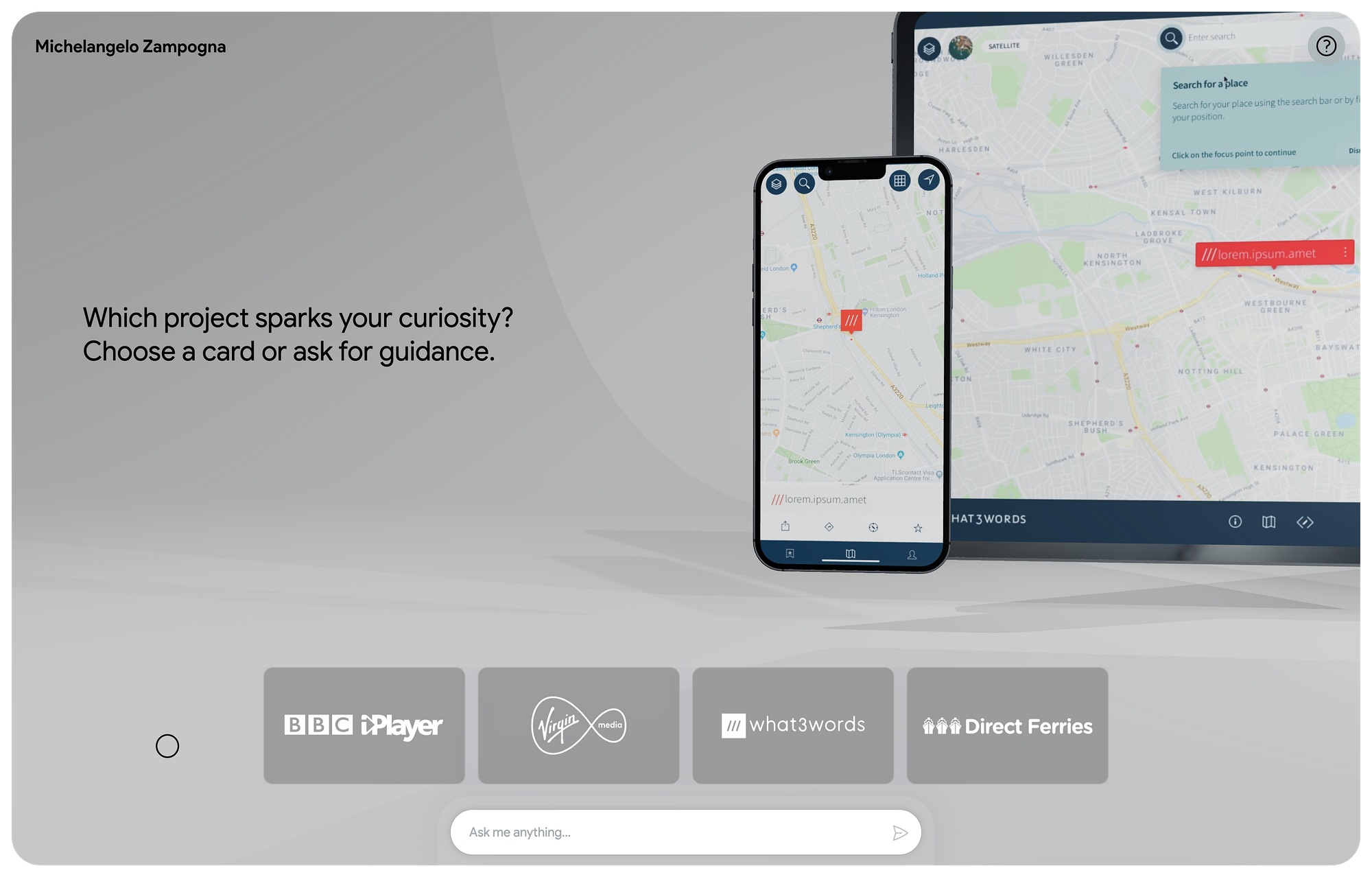
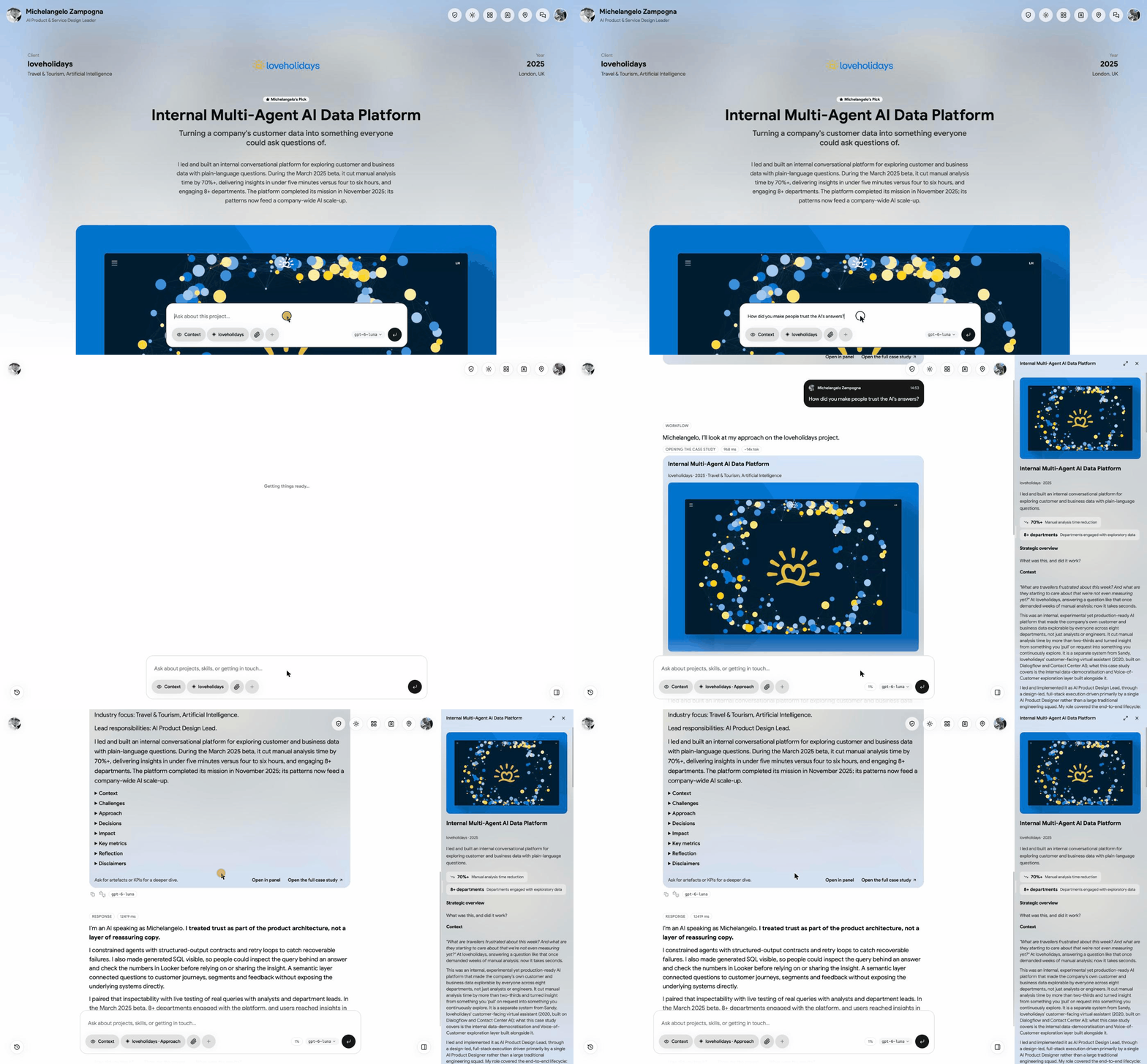
This is my own project, so nothing here is withheld for a client. The screenshots show earlier versions of my own site and the work inside it.
Client logos and screens from other projects appear in these images because the portfolio's job is to show that work. They belong to their owners and are shown to illustrate what I designed, not to suggest any endorsement.
Two of the images here are slides from the behavioural intent model I designed at loveholidays, shown because the admin views were built from them. They hold no loveholidays data.
Key facts
- Client
- Assistx
- Year
- 2026
- Role
- AI Product Design Engineer
- Industry
- Conversational AI
- Location
- London, UK
- Lighthouse accessibility score
- 100
- Lighthouse performance score
- 93
- Question routing confidence
- 0.98 confidence
What was the challenge in Conversational AI Portfolio?
Version one had to bring several technologies together while keeping the experience usable across devices. It could answer questions, but conversation logic was split between Dialogflow intents, prompts and server routes. Adding a capability meant another endpoint and more client-side code, while Dialogflow sat on the critical path for behaviour the product did not fundamentally need.
What did I actually do on Conversational AI Portfolio?
I moved the capabilities into a Model Context Protocol server, where each tool has a typed contract. That gives the system one inspectable place to define what the assistant can do, instead of spreading capability across prompts, endpoints and browser code.
What was the outcome of Conversational AI Portfolio?
The rebuild is live and still evolving. The portfolio is no longer only a conversational front end: its capabilities, evidence model and approval path can be inspected as parts of the product. Measured outcomes: Lighthouse accessibility score: 100; Lighthouse performance score: 93; Question routing confidence: 0.98 confidence.